


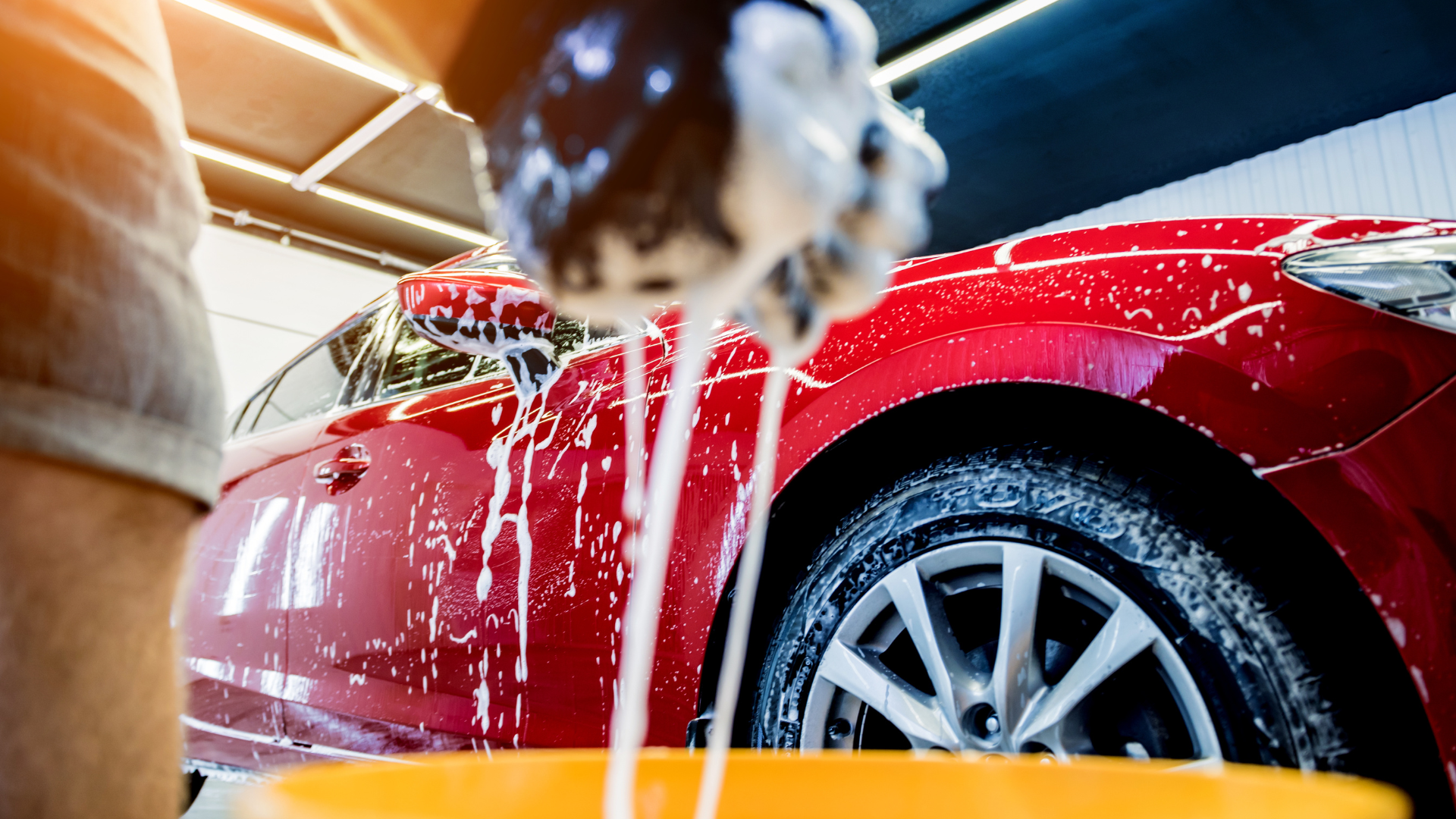
A clean car always turns heads, but what truly separates a basic wash from a professional finish is the complete lack of streaks. Water spots and limescale marks are the ultimate frustration for any car lover.
Luckily, it’s simple to fix: it’s all about pairing the right products with the right tools and a bit of know-how.
Why do marks appear on the bodywork?
To get that flawless look, you first need to understand what these marks actually are and where they come from.
Hard water and limescale
The primary culprit behind unsightly white spots and watermarks is the quality of your local water supply. In many regions, the water is ‘hard’, meaning it has a high mineral content. When water evaporates too quickly from the paintwork, these minerals are left behind, forming stubborn deposits that mark an otherwise perfect finish.
Inappropriate products
Another trap to avoid is reaching for household cleaners. It might be tempting to use washing-up liquid or kitchen soaps because they cut through grease so well, but they’re actually far too harsh for your car. These products are designed for the kitchen sink, not for delicate automotive finishes.
Their unbalanced pH gradually breaks down the protective layer applied to the paintwork, whether it be wax, polish or even a ceramic coating. With repeated use, the surface loses its natural shine, becomes dull and more vulnerable to external damage (rain, pollution, micro-scratches).
Furthermore, these detergents tend to leave chemical residues that are not completely removed during rinsing, creating unsightly and sometimes greasy marks after drying. Instead of protecting the bodywork, they accelerate its visual ageing.
The best option is to use only car shampoos specifically designed to clean gently without damaging the existing protective coatings.
A poor drying
Even when a wash is executed to the highest standards with premium products, a common mistake is allowing the car to air dry. When exposed to direct sunlight, water evaporates rapidly, leaving behind everything it carried: limescale, minerals, and shampoo residue. This results in unsightly water spots, white marks, or a dull film that detracts from the vehicle’s overall aesthetic.
This phenomenon is even more pronounced on dark paintwork, where every streak is magnified under the light. More concerningly, some limescale deposits can become etched into the clear coat, requiring a machine polish to rectify.
This is why a controlled manual dry is essential for a flawless finish. By using a dedicated high-absorbency microfibre drying towel, you ensure minerals are lifted away rather than left to settle on the paint. The sooner the vehicle is dried after the final rinse, the sharper and more radiant the gloss will be.
In short: A wash is only truly successful if you take the time to dry the car properly. It is the definitive final step that elevates a standard clean to a professional-grade finish.
Step 1: Choose a suitable shampoo
Stop using household cleaning products
Forget about washing-up liquid and other household cleaning products of this kind once and for all. Although their degreasing power may give the impression that they clean effectively, their formulation is completely unsuitable for use on cars. In fact, these products often have a pH that is too acidic or too alkaline, which gradually weakens the protective coatings applied to the bodywork.
The result is that the protective wax, ceramic coating or polish used to preserve and enhance the paintwork’s shine is gradually stripped away with each wash. The surface then becomes duller, rough to the touch and much more susceptible to external factors such as rain, UV rays and pollution.
Furthermore, regular use of washing-up liquid tends to dry out rubber seals, dull plastic surfaces, and leave chemical residues that are difficult to remove completely when rinsing. In the long term, this exacerbates the appearance of visible marks once the vehicle has dried and accelerates its overall ageing.
Conversely, a pH-neutral car shampoo is designed to be gentle on the paintwork and existing protective coatings. Some formulations enriched with ceramic or polymer wax even enhance the shine and make washing easier, leaving a water-repellent film that naturally repels water and minimises water spots.
Choosing the right shampoo
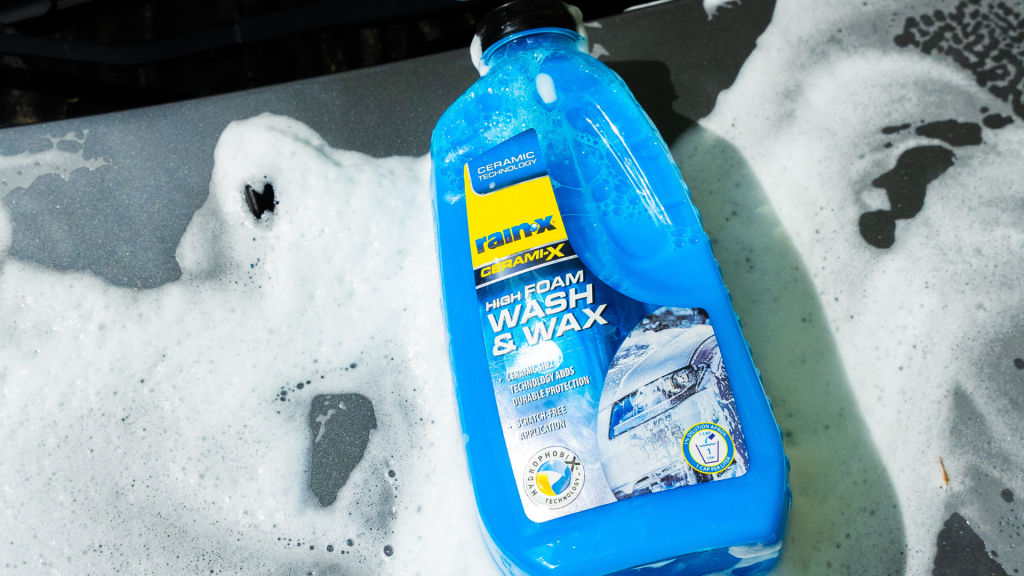
A gentle car shampoo, specially formulated for car care, is the essential foundation of a successful wash.
Unlike household cleaning products, which can be too harsh, it preserves the paintwork’s finish and shine whilst effectively removing dirt, dust, traces of pollution and road grime.
Modern car wash products, which often contain ceramic or water-repellent agents, offer an additional benefit: they do more than just clean; they also leave a thin protective film on the surface of the bodywork. This invisible layer acts as a barrier against water and limescale, allowing moisture to run off rather than pool.
The result: water beads up and runs off naturally, making drying much quicker and easier.
Another benefit of ceramic-enriched shampoos is their ability to enhance shine and colour depth. Even after a single wash, the car regains a glossy finish that rivals a professional one. What’s more, this water-repellent protection makes future cleaning easier, as dirt is less likely to stick to the treated surface.
By choosing this type of car wash, you get a two-fold benefit: an impeccable clean straight away and long-lasting protection that helps keep your car looking brilliant for longer.
And if you’re not sure which car wash to choose, we’ve got the perfect article for you:
👉 Car shampoo: harsh, gentle or ceramic, which one should you choose?
Step 2: Choose a shaded spot and a cool body
Prevent excessive evaporation
Washing your car in direct sunlight is THE thing to avoid if you want a streak-free finish.
When exposed to heat, water and shampoo evaporate far too quickly, leaving behind whitish marks caused by the limescale in the water. These marks then quickly set into the bodywork and can be very difficult to remove afterwards.
To avoid this problem, it is essential to create the right conditions for washing. Always choose a shaded spot, such as a garage, a garden shed, or simply an area in the shade of a building or a tree. If this isn’t possible during the day, wait until late afternoon or evening, when the car’s bodywork has cooled down.
A cool body allows you to work without rushing:
🧼The shampoo works effectively to lift dirt without drying out the surface immediately.
🌊Rinsing is more effective and leaves no detergent residue.
🌬️Drying with a dedicated microfibre ensures uniform coverage, guaranteeing a streak-free, flawless finish.
By following these simple steps, every wash becomes more effective, more enjoyable and, above all, free from unpleasant surprises when it comes to drying.
Step 3: Rinse and dry thoroughly
Rinsing with clean water
A thorough and meticulous rinse is a pivotal stage in ensuring a flawless result. Whether using a pressure washer or a standard garden hose, the key is to use sufficient water volume to completely flush away every trace of shampoo. Indeed, if product micro-particles remain bonded to the bodywork, they will dry alongside the water, creating a dull, hazy film.
This phenomenon is particularly striking on dark-coloured cars, where even the slightest streak is immediately highlighted by the light. On lighter vehicles, these deposits may be less obvious to the naked eye, but they still contribute to a loss of clarity and gloss over time.
A proper rinse isn’t just about removing foam; it’s about rinsing until the water sheets off clearly and uniformly. This is the definitive sign that the surface is decontaminated and residue-free. For maximum efficiency, we recommend starting from the roof and working your way down to the sills, ensuring the gravity-fed water carries all loosened dirt away from the vehicle.
Once this rinse is correctly executed, the drying process becomes far more efficient, significantly reducing the risk of water spotting or unsightly marks during your car wash.
The best microfibre cloths for cars
Choosing a microfibre cloth is absolutely crucial for achieving a streak-free finish. Unlike traditional towels or old rags, microfibre is made up of ultra-fine fibres capable of absorbing a large amount of water without spreading it around or leaving lint behind. It glides easily over the bodywork, reduces friction and thus minimises the risk of micro-scratches.
For best results, we recommend using two complementary types of microfibre:
- The XXL microfibre drying cloth: thick and highly absorbent, it quickly removes most of the water in just a few passes. It is ideal for large flat surfaces such as the bonnet, roof or doors.
- The finer finishing microfibre cloth: this is used for a second pass to remove the very last drops of water from corners, around the wing mirrors, on the trim or near the logos. This final step prevents unsightly streaks from forming and ensures a uniform shine.
Tip: Always fold your finishing microfibre cloth into quarters to maximise the number of clean surfaces available, and change it as soon as it becomes too damp. This ensures a gentle car body care routine and helps maximise the lifespan of your tools.
Proper drying techniques
After washing and before applying a ceramic coating to your car, drying is a crucial step in protecting the paintwork. Improper drying can leave water marks, micro-scratches or limescale deposits, even on a protected bodywork. For a professional-quality finish, it is essential to use the right tools and follow a rigorous method.
For large surfaces such as the bonnet, roof or boot, use an ultra-soft XXL microfibre cloth folded into several layers. Rather than rubbing or dabbing, simply place the microfibre cloth on the bodywork and let it absorb the water through capillary action. This technique removes excess water without applying abrasive pressure and helps maintain the paintwork’s shine. Once the water has been absorbed, you can remove the microfibre cloth by gently lifting it vertically to avoid putting water back onto an area that has already dried.
There is also the ‘dragging’ technique, which simply involves laying the towel flat over the area to be dried and gently pulling it outwards towards the edge of the vehicle. The weight of the towel, combined with its capillary action, is sufficient to absorb the water.
For more delicate or hard-to-reach areas, such as door seals, door handles, the bottom of the doors, the grille, or the wing mirrors, it is advisable to use a smaller, softer microfibre cloth or a filtered hot-air blower. This method allows you to dry hard-to-reach areas without spreading water or causing streaks, whilst minimising the risk of micro-scratches. It is also important to open the doors, boot and fuel filler flap to remove any standing water in hidden areas.
To ensure even drying, make sure you change the microfibre cloth as soon as it becomes saturated and work section by section, always moving from top to bottom. Finally, finish with an ultra-soft precision microfibre cloth to remove any remaining droplets, ensuring the surface is perfectly dry and ready for a ceramic coating or wax.
By following this method of combining XXL microfibre cloths for large surfaces, small microfibre cloths for the finer details and a blower for hard-to-reach areas you’ll achieve a quick, safe and even dry, just as professional detailers do, whilst providing long-lasting protection for your car’s paintwork.
And for more tips on how to make your car shine, do take a look at our article on the subject.
Step 4: The water-repellent finish
Why protect the bodywork after washing?
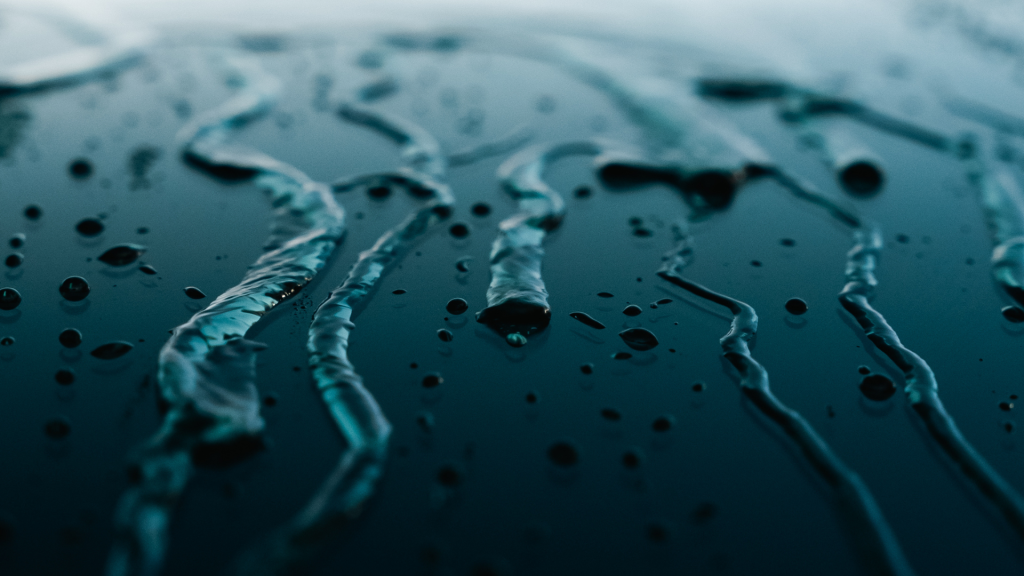
Even after a thorough wash, the bodywork remains exposed to external elements: rain, pollution, dust, road grime and splashes. Every time you drive out, the cleanliness you’ve achieved can quickly be compromised, bringing back those unsightly marks that you’re trying to avoid in the first place.
This is where the water-repellent finish comes in – a key step that is often overlooked but essential for maintaining the shine and protecting the paintwork. By applying a water-repellent spray or wax, you create an invisible protective layer that alters the surface tension: instead of spreading out, water beads up and rolls off immediately, carrying some of the dirt away with it.
This treatment offers several benefits:
- Prevents limescale and water spot marks by minimising contact between water and the surface.
- Makes car bodywork easier to maintain: dust and dirt stick less, making future washes quicker.
- Extends the shine: the paintwork retains its lustre as if it had just been polished.
A properly applied water-repellent finish therefore not only completes a perfect wash, but also helps to preserve the vehicle’s appearance for longer whilst reducing the effort required for subsequent maintenance.
You can find out more about our protective treatments for car bodywork by reading the article right here 👇
Why choose a ceramic coating for your bodywork?
Recommended products
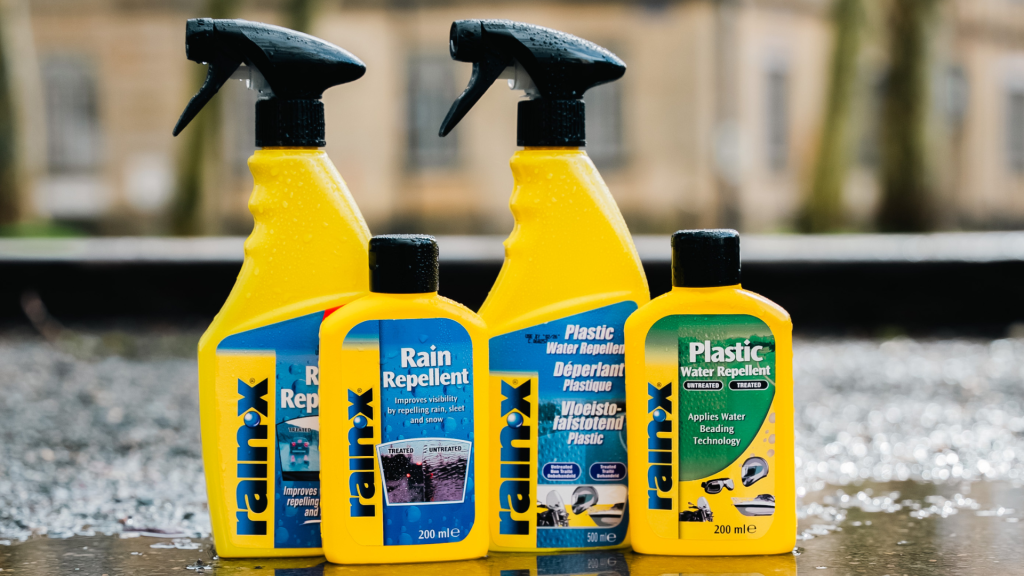
- Rain-X Rain Repellent: this product and the entire Rain-X range of water-repellent products – is specially designed to repel water spectacularly. When applied to windows, it significantly improves visibility in the rain, as water beads up and runs off effortlessly as soon as the vehicle is in motion.
- Instant Wax: this quick-fix solution is ideal for those who want to protect and enhance the appearance of their vehicle without going through a lengthy waxing process. It’s easy to apply, simply spray the product on and wipe it off with a suitable microfibre cloth.
The result: enhanced shine, deeper, richer colour and a light protective layer that acts as a shield against water and dust. It’s the perfect choice for a quick yet polished finish.
- Ceramix High Foam Wash & Wax + Microfibre: this duo offers an effective balance between time-saving and performance. The ceramic-enriched shampoo leaves a water-repellent protective layer immediately during washing, whilst the microfibre drying cloth ensures a flawless, streak-free finish. This combination is particularly popular with enthusiasts who want to maintain a brilliant shine and a protected bodywork without adding extra maintenance steps.
Building a quick and effective routine
A spotless wash doesn’t have to be time-consuming. By adopting a simple routine, you’ll save time and always achieve a flawless finish:
- Wash with a suitable car shampoo.
- Working in the shade.
- Dry using a dedicated microfibre cloth.
- Finish with a water-repellent coating.
By following these steps regularly, car bodywork maintenance becomes simple and effective, and your car will retain its impeccable shine for longer. And for even more tips, do take a look at our special article on maintenance and showroom shine.